
Corbell
The Duke of Wellington's Regiment (West Riding) 6oz Jug. SKU #: C1420.
- SKU:
- C1420
- UPC:
- 3113434112342
- Condition:
- New
- Shipping:
- $0.10 (Fixed Shipping Cost)

Description
The Duke of Wellington's Regiment (West Riding) A brief history of The Duke of Wellington's Regiment (West Riding) The Regiment has been in existence for 296 years and today is one of the handful that have not been disbanded or amalgamated since the Infantry of the Line was reorganised in 1881. The 33rd was raised at the outbreak of the Spanish war of Succession in 1702. It soon established a reputation for excellence and by the 1770's was described as the best trained in the Army. this was due to the influence of Lord Cornwallis who was Colonel of the Regiment from 1766 - 1805. It was under Lord Cornwallis's Colonelcy in 1782 that the Regiment was first formally linked with the West Riding of Yorkshire, in recognition of its then already long established practice of recruiting its soldiers from this part of the country. It became known as the 33rd (or 1st Yorkshire West Riding) Regiment. In 1793 Arthur Wellesley, later Duke of Wellington, purchased first his Majority and then six months later his Lieutenant Colonelcy in the Regiment. He was then 24 years old. He remained in command of the Regiment until 1802 taking it first to Holland and then on to India. In 1806 he succeeded Lord Cornwallis as Colonel holding the appointment until he relinquished it, with some reluctance, in1813 to take up the Colonelcy of the Horse Guards. The 33rd subsequently also fought under him at the Battle of Waterloo in 1815. It was because of this long and particularly close relationship with the Duke that, after his death in 1852, the Regiment was granted the title of "The Duke of Wellington's Regiment", a unique distinction as it is the only regiment in the British Army to be named after a commoner. The 76th was raised in 1787 for service in India where it greatly distinguished itself in the wars against the Maharattas which led to the capture of Delhi and Agra amongst other major Indian cities. For its service in India it was awarded by the East India Company an honorary stand of colours, making the Regiment the only one to carry four Colours on parade, and the badge of an elephant circumscribed by the word "Hindoostan". It was under the reforms of the Army in 1881, when the 33rd and 76th were linked together to become the 1st and 2nd Battalions of The Duke of Wellington's Regiment West Riding, that their home barracks in Halifax were built for them. Though the barracks closed in 1957 the Regiment's headquarters are still in the town. During the 1st World War twenty one Regular, Territorial and Service battalions of the Regiment were raised with their men drawn almost entirely from the West Riding. Of these, fourteen battalions saw active service on the Western Front, Italy, and at Gallipoli, suffering the loss of 8,000 men and officers. During the Second World War, battalions of the Regiment participated in the campaigns of Dunkirk, Northwest Europe, North Africa, Italy, and Burma. Since then the 1st Battalion has seen active service in Korea, where at the Battle of the Hook it held the critical approaches to Seoul, Cyprus, Kenya, numerous tours in Northern Ireland and Bosnia where, in 1994, it was the first unit into Gorazde and played a critical role in helping to prevent a similar tragedy to that which befell Zepa and Screbrinica.
View AllClose
Related Products
Related Products


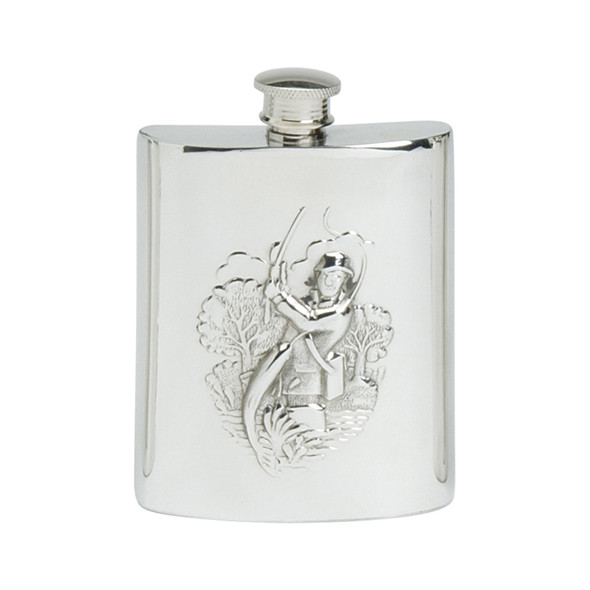


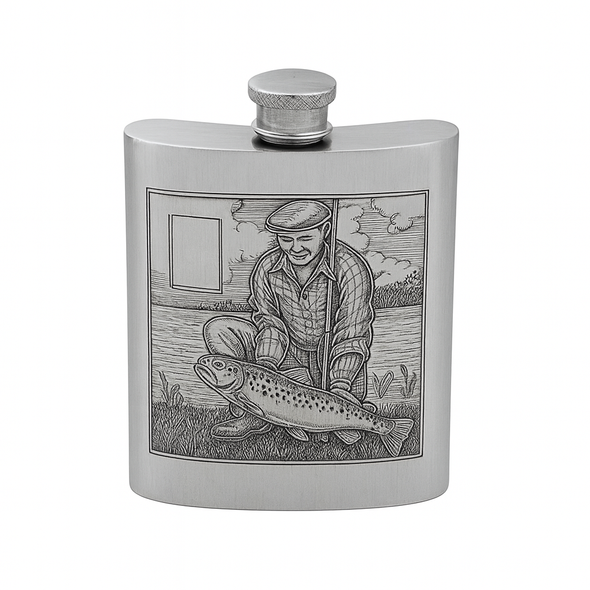
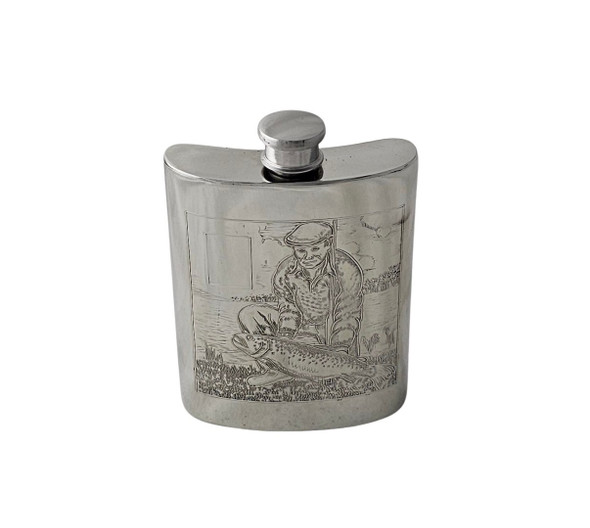
Fishing Scene Pewter Flask 6oz. SKU #: EB32400.
Corbell
$110.00
6oz English Pewter Fishing Scene Flask – Double-Sided with Gift Pouch & Presentation Box Celebrate the spirit of the outdoors with this exquisitely crafted 6oz English pewter flask, featuring two...